Sunday, 28 June 2015

UCLan students support charity strongman event


Four UCLan Sports Therapy students gained valuable industry experience as some of the UK's largest athletes battled to be crowned Blackpool's Strongest Man.

The quartet played a key role in offering soft tissue therapy support to competitors who had gathered in the resort to take part in a series of exciting challenges.

Lecturer Rob Hamilton said it was a fantastic opportunity to consolidate their hands-on therapy skills in a very unique environment.

"The event helped the students hone their handling skills and fine tune their techniques on a very different body type than they had previously encountered," said Rob.

"The feedback from the athletes was second to none, praising the benefits they experienced and how much it helped them to perform to their best ability."

Organised by the Lancashire-based Our Local Heroes Foundation charity, the event formed part of Blackpool's Armed Forces Week celebrations.

After a gruelling day of tests including a truck pull and a car deadlift, Dale Peters was crowned champion with Ryan England runner-up and Jon Bleach in third.

Student Nicole Benson said working at the event was an enjoyable experience: "Massaging such muscular athletes was a lot different to what I've done during my first year. It's given me more much more confidence in my skills and I was really pleased to receive positive feedback about my work."

Andrew Ball added: "The event was an excellent learning experience for me. I picked up different techniques from the other therapists and I feel this will be of big benefit to me when I progress onto my second year."

To view a selection of pictures from the event please click here.

Monday, 22 June 2015

Zambia trip a life-changing experience

Our programmes provide many opportunities for students to gain valuable work experience before they start their careers.

Sports Therapy student Sam Heap recently accompanied colleagues from various schools across the university to Africa as part of this year's UCLan Sport for Development Project trip.

Established in 2008 by Cliff Olsson, Senior Lecturer in Sport Coaching & Development in the School of Sport, Tourism and The Outdoors, the project gives undergraduates the opportunity to study the global value and contribution sport can make towards supporting the Millennium Development Goals.

The scheme aims to actively support Sport for Development projects being delivered in some of the poorest parts of the world by agencies such as Sport in Action and Zambia-based Edusport.

Sam said the trip was an eye-opening experience: "HIV, AIDS and drug abuse is a massive issue in Africa. We had to teach and educate the children about these problems through the use of sport. It was challenging at first because of the language barrier, but with the help of other peer leaders we managed to overcome this.

"We spent the first week in a community school with three of us looking after over 200 children. Some of them were really badly behaved and it was very challenging. We later moved on to a government funded school which was more structured, but still testing.

"The trip was a big culture shock but also very life-changing for me. In the UK you can donate to charity, but to be able to actually go there and see what the problems are was an enlightening experience."

In the past few years UCLan students have raised over £10,000 towards buying basic sports equipment and supported the building of basketball courts in local rural schools in Zambia.

The project has also provided the opportunity for local voluntary sports leaders from Zambia to come to Preston and share their skills and knowledge with local community volunteers and children from local schools.

In addition to making a difference to people's lives, the trip offers students the chance to apply their skills in a different environment than they are normally exposed to. Sam said this would be a big help to her in the future.

"Going to Zambia has definitely opened my eyes to some of the opportunities that are open to me," said Sam. "Rather than just thinking I'd be working with adults, it's enhanced my skills so I can now consider working with children in sport or in other areas.

"I'd like to go back in 2016 to gain even more experience. I've been told I did well on this year's trip, so I'm hoping to return as a Team Leader. It would be great to see how the money we've raised has been spent and what changes have been made to the children's lives."

To view pictures from the trip please click here.

Thursday, 18 June 2015

Stressed? Let our qualified staff help

Stress is a natural part of life that can be beneficial to your health and safety.

Stress can be triggered by numerous pressures related to everyday responsibilities, negative life events, physical illness, and traumatic stress such as disaster or a violent attack.

However, when we fail to recognise a build-up of stress in our lives and take on more than we can handle it can be detrimental to our health.

The body's natural reaction to stress

The body releases hormones and increases breathing and heart rates when reacting to stressful situation, leading to the brain receiving more oxygen and helping to cope with difficult situations in the short term.

Effects of stress on the body

Although we know that long term untreated stress can lead to anxiety and depression, stress also affects various systems within your body. Stress has a negative impact on your digestive system, muscular system, and respiratory and cardiovascular systems.

Digestive

When you are stressed your liver produces extra blood sugar, which the body reabsorbs when unused. However, if you are constantly stressed, your body may not cope with the increase in blood sugar levels, leaving you at risk of developing type 2 diabetes. You may also experience acid reflux and heartburn, nausea, vomiting, or a stomach ache.

Muscular

Muscle tension is a by-product of stress and can become problematic, as the muscles don't have the chance to relax when the body is stressed which can lead to headaches, back and shoulder pain, and body pain. These problems can be treated with pain relief medication but to avoid long term problems it is important they are treated with physiotherapy.

Respiratory and Cardiovascular

Stress can have a significant impact upon your cardiovascular and respiratory systems. When stressed you breathe faster to distribute oxygen and blood quickly to the body in order to relax. However, if you have a health problem such as asthma or emphysema the reaction to stress can worsen the condition.

As well as rapid breathing the heart also pumps faster when stressed. Blood vessels then constrict and increase blood pressure due to stress hormones, helping with the delivery of oxygen to the brain and heart to provide greater energy.

Although temporary stress can be beneficial in the short term, chronic stress can put too much pressure on your heart, increasing risk of hypertension and heart problems. It also leaves you at higher risk of having a stroke or heart attack.

According to reports 43% of all adults suffer from stress related health issues, whilst up to 90% of doctor's visits are for stress-related complaints.

Physiotherapy is great for relaxing the body, having many benefits:
  • Reducing muscle tension
  • Decreasing tiredness
  • Improving concentration span
  • Decreasing blood pressure
  • Reducing risk of cardiovascular disease
  • Reducing pain such as headaches and chronic pain syndromes
At the UCLan Physiotherapy Clinic your Chartered Physiotherapist will treat areas of muscle tension with massage and stretches, teach you the necessary relaxation techniques and give you appropriate advice.

Should you need more specialist help, your physiotherapist will liaise with your doctor to ensure that you are referred for appropriate counselling and treatment.

To begin your journey to a stress-free life please call 01772 894902 or email us for an appointment.

Wednesday, 27 May 2015

New support network for researchers launched

Dr Hazel Roddam presented a workshop at the 9th CPLOL Congress of Speech and Language Therapists to launch a unique EU-wide peer support network for the profession.

The purpose of the scheme is to support research capacity building, as a key priority action for embedding evidence-based practice and helping experienced clinicians contribute to the professional evidence base.

The new network will be led by Dr Roddam, assisted by Mette Thomsen from the University of Copenhagen and UCLan PhD student Gina Carey.

This will be a two-tier peer mentoring scheme - the network leaders will mentor contacts in each country, who will then provide research skills mentorship to clinical practitioners.

Dr Roddam commented: "We were delighted that 25 individual participants from 18 countries all signed up to participate in this initiative. An initial report will be presented to CPLOL and a paper submitted for publication in the leading international peer-reviewed professional journal."

Dr Roddam is pictured above with Professor Maria Vlassopoulou from University of Athens Medical School, who is CPLOL's Vice-President for Professional Education.

Tuesday, 26 May 2015

Physiotherapy and Strokes

May is Action on Stroke Month, raising awareness of the risk factors associated with strokes, as well as how to spot the symptoms and treat someone who has suffered a stroke.

According to the British Heart Foundation approximately 152,000 people have a stroke each year, with 76% of stroke survivors being left with disabilities and requiring rehabilitation through physiotherapy.

What is a stroke?

A stroke is a sudden 'brain attack' that occurs when the blood flow is cut off to part of the brain (infarct), or due to bleeding within the brain (haemorrhage). Usually this is due to a blood clot. Some strokes are fatal while others cause permanent or temporary disability.

Emergency medical treatment should be sought soon after symptoms begin, as the longer a stroke remains untreated the greater the chance of brain damage and the more difficult recovery becomes.

Stroke is more common in men and in people over 55, although it can occur at any age. Risk factors include: a family history of strokes, diet, drinking alcohol, smoking and lack of exercise, although sometimes there is no obvious cause.

Action to be taken

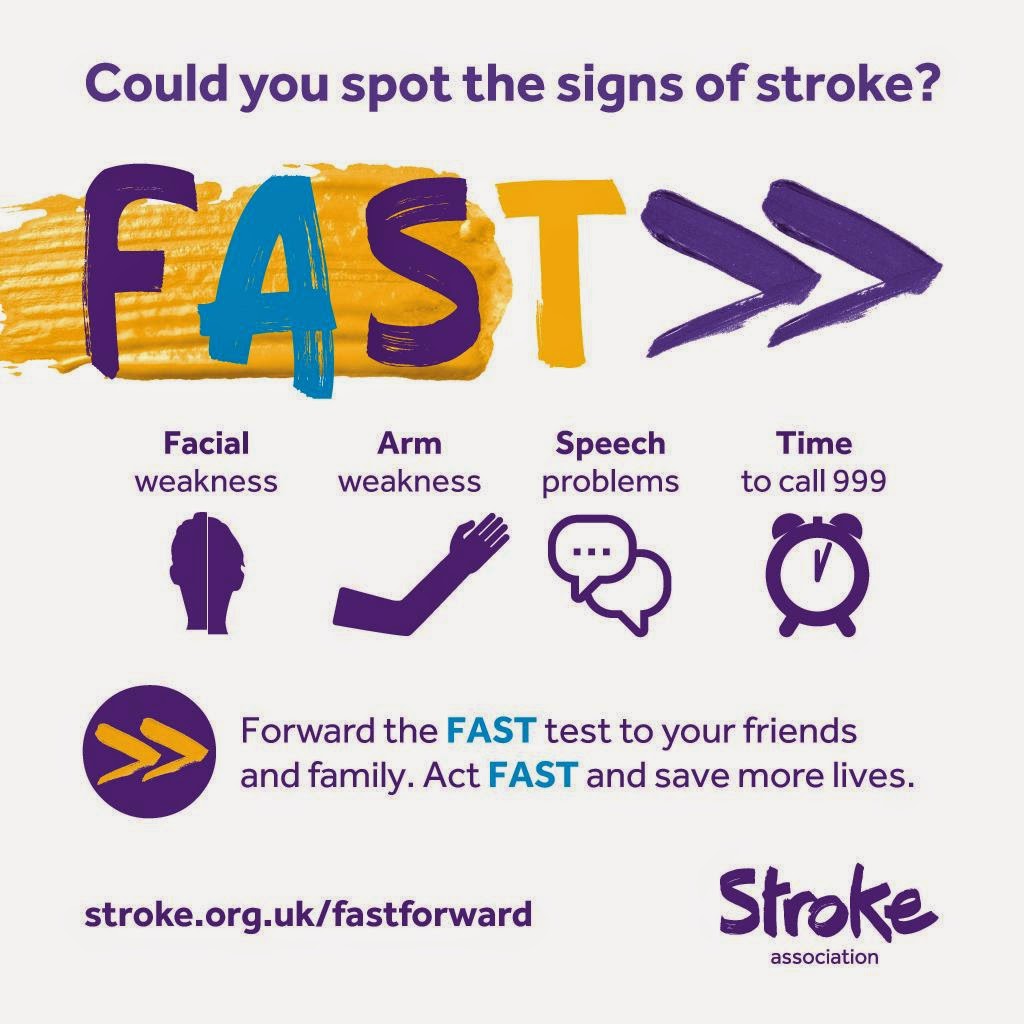
F ace – Check their face. Has their mouth drooped?
A rms – can they lift both arms?
S peech – Is their speech slurred? Do they understand you?
T ime - Is critical - if you see any of these signs call 999 immediately.

Effects of a stroke
  • Weakness or complete paralysis in muscles on one side of the body
  • Limbs on the effected side of the body may feel heavy and numb, or sensations similar to pins and needles
  • Postural issues affecting balance
  • Stiff muscles on the affected side of the body
Treatment

Physiotherapy is essential for recovery from a stroke, particularly neurophysiotherapy, which treats problems that originate in the brain and therefore it is important to receive this form of therapy for at least some part of the recovery process.

The brain is incapable of replacing damaged cells with new ones after a stroke, so recovery is reliant upon the ability to reorganise the undamaged cells. This is called neuroplasticity.

Physiotherapists will often work with other specialists to treat a variety of issues, with the aim of the rehabilitation team being to make sure a patient is as active as possible, as soon as possible after a stroke to avoid issues such as stiff joints and muscle tightness.

Guidelines recommend at least 45 minutes of physiotherapy per day to strengthen muscles (as well as any other therapy required).

The sooner a stroke is treated, the survival rate increases and the chance of successful rehabilitation significantly improves. Physiotherapy is essential for recovery and should be started as soon as possible.

UCLan's Physiotherapy Clinic offers treatment for neurological issues, providing services to the general public as well as staff and students of the university, from £30 for an initial assessment and £35 for physiotherapy for stroke. They are a recognised provider of Physiotherapy services for many insurance companies including BUPA.

For more details please click here or telephone 01772 894902.

Friday, 22 May 2015

Research team enjoy BOB North buzz

Staff from UCLan's Allied Health Research Unit (AHRu) showcased their work at Preston's inaugural Best of Britannia (BOB) North event.

Over 3,500 people visited the pop-up department store which had set up outside of London for the very first time.

UCLan was a key sponsor of the event which took place in the historic Post Office building and Market Square in the heart of the City.

The AHRu team were joined by a variety of current and previous partner companies who helped to demonstrate a range of work relating to design for sport and rehabilitation.

These included Optifit Bra Company, who the team have been working with to conduct research into the effect of breast support garments on back pain.

CERAGEM Preston UK, who collaborated on a previous study into the effectiveness of their V3 bed for individuals with non-specific back pain, were also on hand throughout the weekend.

CERAGEM'S Julie Gyi commented: "We were proud and happy to be showcasing innovative therapy products that really do make a difference. So many visitors tried and loved the Ceragem thermo-therapeutic massage bed. There was a real buzz in the air and we had lots of fun too. Thanks to the Allied Health team for the opportunity to reach out and help even more people."

Other companies in attendance included Rophi Cushions, MDTi and Leeds-based bed manufacturer Harrison Spinks, with whom Professor Jim Richards has developed the innovative P 1.0 Trainer which is due to be released in the UK this summer.

The team also displayed a range of other products they have previously tested, including Lift Slings, Lumbacurve and many DJO Global products.

The AHRu performs applied research which includes the design and development of new products for sport and rehabilitation.

The unit works with Small Medium Enterprises (SME) and large international companies across the healthcare products, medical devices, sports and outdoor equipment sectors. Its advanced biomechanics, healthcare technology, sports and outdoor testing facilities have hosted a range of product testing.

Thursday, 21 May 2015

Dr Roddam gives keynote address at showpiece event


Dr Hazel Roddam recently delivered an invited keynote address at the 2nd Baltic Congress of Speech and Language Therapists, held at the University of Šiauliai in Lithuania.

Dr Roddam also met with research partners to discuss future collaborations, with the first link up being the creation of an Erasmus+ research traineeship for a PhD student from Šiauliai who will travel to UCLan during the next academic year.